Although there was a football match last night that mostly stopped the town (we think Ecuador won, it was 1-0 in the 80th minute), this is more about our impressions on the countries as a whole.
First of all, Peru is expensive. If you look at some guidebooks, they'll tell you that Peru and Ecuador will cost you about the same, and Bolivia too. How far from the truth that is. Food in Peru is costing us about $15/day more than Ecuador. Hotels in Peru are only slightly more expensive, but rarely include breakfast. In Ecuador it was hard to find a place that didn't include breakfast. [Having to buy breakfast accounts for almost half the $15.] Taxis cost at least double in Peru, and buses are more like 4 times as expensive. We got from Cuenca to Loja in Ecuador (5 hour ride) for less than it cost us to get from the airport to our hotel in Lima, and for about half the cost of the bus from Paracas to Ica (1.5 hours). We'll be arriving in Bolivia sooner than anticipated; the word on the street is that it's very, very cheap.
The food in Peru has been tastier than Ecuador. The local food is more interesting (Ecuadorian food was a little bland), and the Peruvian take on foreign food is better too. I guess you get what you pay for?
Internet in Peru has been spotty or non-existent. Even in Lima it was touch-and-go. Phone calls are also more expensive in Peru.
The small Peruvian towns are more ramshackle than the small Ecuadorian towns. The big cities (Lima, Arequipa vs. Quito, Cuenca) are fairly similar.
Taxis in Peru are apparently rather dangerous. In Ecuador you just walked outside, stuck your arm out, and caught a cab. In Peru that is a no-no, and you arrange for a taxi through your hotel. I guess some taxis (that you might pick up off the street) will hold you or your luggage hostage if you don't pay extravagant fees.
Lots of Peruanos speak at least some English, and many speak a little French and/or German too. People will automatically start speaking English to us. We know we look like gringos! Although it's probably a polite gesture (as is our trying to speak Spanish), it ruins the experience a little when folks stop speaking Spanish. On the other hand, it is nice when our vocabulary fails us to sprinkle in a few English words and be perfectly understood.
On a related note, there is a bit of an accent in Peru. We mostly noticed it in Lima, but it crops up every now and then. Some people drop some consonants from some words, usually an "s". It's inconsistently applied, which makes it harder to get used to. It tends to trip us up occasionally. For example, "gracias" becomes "gracia". That's not so bad. But "mismo" becomes "mimo" and missing letters in the middle of the word are tricky. 60 and 70 become almost indistinguishable if spoken quickly: seenta vs. setenta. The accents in Ecuador were easier to deal with since it was mostly just the added "j" sound to the "ll" when in the mountains and everyone used it.
Wednesday, November 16, 2011

Tuesday, November 15, 2011
Touring the Peruvian Atacama Desert
The Atacama Desert is, by most accounts, the driest in the world. After visiting deserts in the US, we can definitely say that Peru is not joking. Death Valley was comparatively the Garden of Eden. We spent several days in the southern Peruvian section of the desert, and will visit the Chilean portion later in the trip.
Lima is basically in the desert too, but we didn't really notice it as much in such a big city. As soon as you leave, however, things start to look bleak (stark? might be a better word). Our first stop was Paracas, a little village just outside a national park of the same name. Paracas is just south of Pisco, purportedly the source of both pisco the liquor and the pisco sour. More on pisco later... We arrived not long before sunset, got our room, and ate dinner at one of the restaurants overlooking the marina. Half the boats were fishing boats, the other half tour boats for taking folks to the islands just offshore. Dinner included several rounds of both pisco sours and maracuya sours (same thing but with the addition of maracuya juice--yellow passion fruit). The pisco sour is, of course, the national drink and we're all about getting to know the local food culture. Sacrifices.
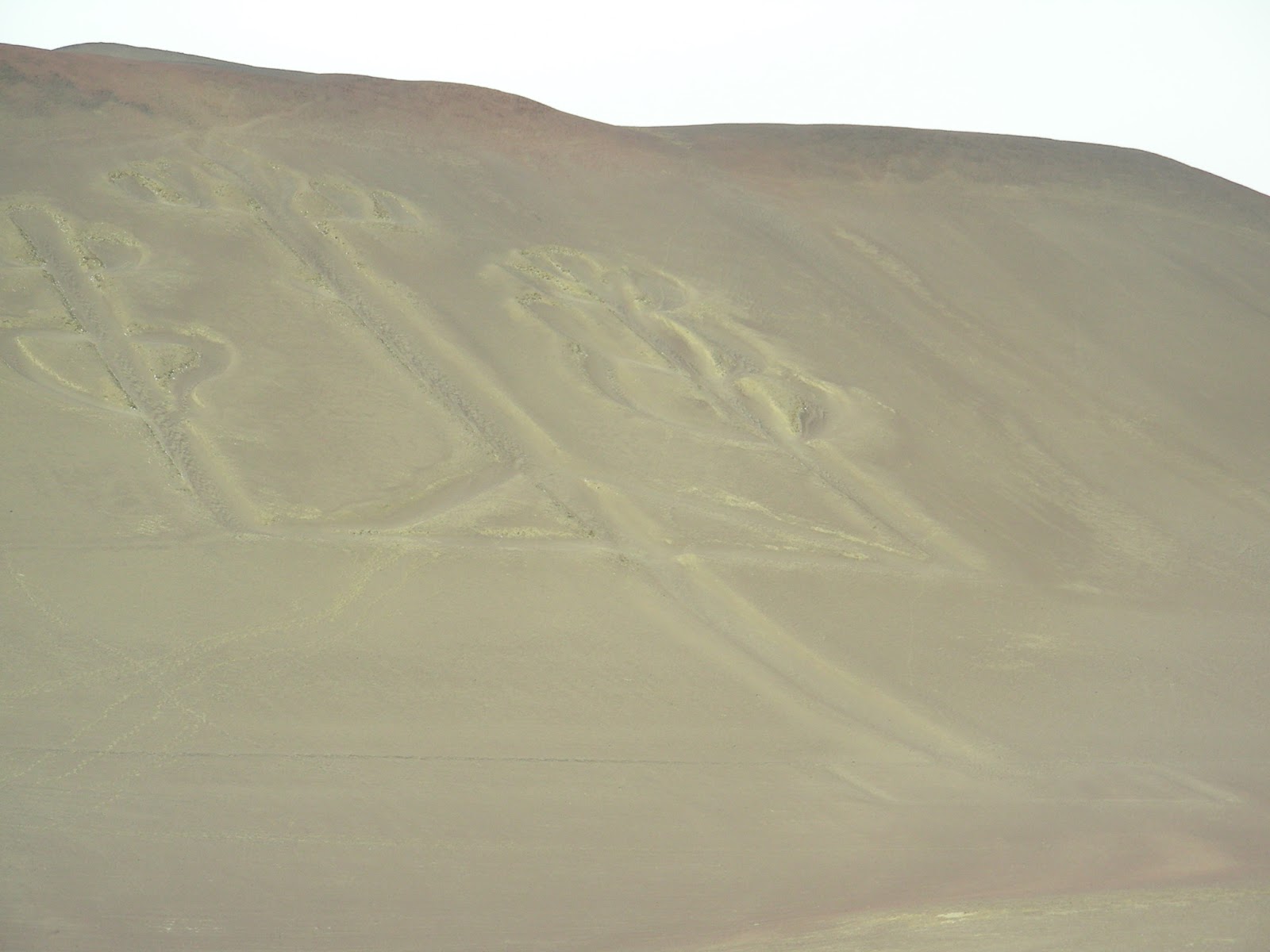
The hotel was rather noisy at night, being the location of one of the town's all-night bars. The party eventually stopped at 6am. Ugh. Not long after, we were headed to the boats. Our sardine-packed boat took us past "The Candelabra" geoglyph carved into the rocks some 2300 years ago. They told us it was probably a cactus and not a candelabra, but apparently the name stuck. After that we headed to the Islas Ballestas, which are part of the Paracas park. Here were thousands of birds of several species, including some very cool Inca terns, Peruvian boobies (no blue feet unfortunately), Humboldt penguins, and a few kinds of cormorants we hadn't seen before. Also on the islands were lots and lots of guano. And the smell. Some poor souls were tasked with harvesting the guano for use as fertilizer. The guide said an area of the island is harvested every 8 years and in that time 70 cm of guano is deposited. Holy crap! On the way back to shore, our boat had some mechanical difficulties. Much engine fiddling ensued, and whatever it was was resolved.


After arriving back on shore, late, we had a few minutes to get ready before heading to the land portion of Paracas park. We got stuffed into a van and drove the 15 minutes to the park (we're not very used to organized tours in our travels). After some time at the brand new visitor center, we visited various spots in the park. The landscape was stark and beautiful, with the desert going right up to the ocean. We stopped at a tiny fishing village located in the park for a late lunch of ceviche and soup. Mmmm, fresh fish. They brought out a platter of the "fish of the day" covered with 6 kinds of fin fish, shrimp, and scallops. Very fresh.


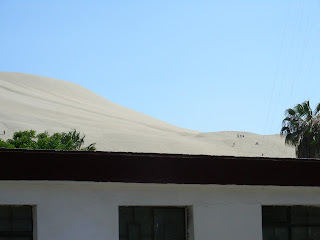
Not too long after getting back, we caught our bus to Ica, the next large-ish town moving south down the coast. Ica had a pretty big earthquake a few weeks ago, but we didn't see much in the way of damage. We didn't actually stay in Ica, but in Huacachina--the oasis town 5 km away. The hotel we were slated to stay in was hosting a disco that night, so we moved to their sister hotel down the road. Still loud, but a lot quieter. Huacachina is surrounded by huge dunes (HUGE.... like 20 stories tall huge) and centered on a rather green lake. Again, stark and beautiful landscape but distinctly desert.

In the morning we headed out to visit some local wineries. The first one was a big producer with a ton of land and buildings and equipment going back to the late 1500s. The wine was not bad, but the pisco was pretty harsh. We got a bottle of Brut (sparkler) for the reasonable price of S/.21. (That's about $8.) Our next stop was a smaller producer specializing in Peruvian-style wine. [We were told that the larger producers made wine to fit international tastes, while Peruvians like the sweeter wines produced in the local style.] The Peruvian desert is hot, as you might imagine, so the wines are naturally strong (16%) and wind up being a bit cooked in the heat. This is remedied by blending with juice, if we understood correctly, to bring the alcohol down a bit and the sweetness up. Local grapes are also a bit sour, so the sweetness covers that too. The wines had a little nutty character, which some of the guide books say is like sherry but really it's totally different. Not bad at all, though not really our style. The pisco at the second place was significantly better as well.


The most striking part of the tours was how much agriculture was in the desert. And remember, this is the driest desert in the world. It doesn't rain. Some pretty crazy irrigation was in place, however: wells, diverting the river when it runs once a year to flood the fields, and continued use of aqueducts bringing water from the mountains. The aqueducts were built at least 1000 years ago. Crazy. In addition to grapes, we passed fields of corn and cotton.
After the short trip back to Ica from Huacachina, we took yet another bus to Nazca (aka Nasca). We wound up with a very nice hotel not far from the very busy and beautiful central square. In the morning we took a ride to the local airport for our trip to see the Nazca lines. We had to wait for about 3 hours, however, before a plane was available to take us. That was not in the brochure. Ah well, we got in our tiny plane with just the pilots and two other tourists. We flew over the lines for about half an hour. The pictorial lines were fairly small in size, but the geometric ones sometimes extended further than we could see. Quite impressive. You could also see tire tracks in the desert and significant damage of the lines all along the Panamericana highway. That was a little sad to see. (In the pictures you can see some triangles & straight lines, a monkey, and a hummingbird.)


After getting back to Nazca, we hid from the sun for a few hours (the desert is really hot) and then walked to the outskirts of town to see the museum. What a cool museum! Inside were details about the various excavations in the area and tons of artifacts. Pottery, statuary, woven bowls, etc. Most impressive were the textiles, both for the beautiful designs and the fact that they had survived ~1500-2000 years in such good condition. Also included in the exhibits were some trophy heads that were apparently used as ritual offerings. There were replicas of the tombs found in the area, and perhaps the coolest part of all was the actual Nazca aqueduct they had out back, still flowing with water (too bad we forgot our camera...).
We hung out at our hotel until 9pm, then headed to the terminal for our overnight bus to Arequipa. As usual, it was late (it originated in Lima). The bus was dark and quiet, but unfortunately the winding mountain roads and the general craziness of Peruvian bus drivers (more insane than their Ecuadorian counterparts, we think) made it impossible to sleep. Our first stop in Arequipa was our hotel, and a nap.
Lima is basically in the desert too, but we didn't really notice it as much in such a big city. As soon as you leave, however, things start to look bleak (stark? might be a better word). Our first stop was Paracas, a little village just outside a national park of the same name. Paracas is just south of Pisco, purportedly the source of both pisco the liquor and the pisco sour. More on pisco later... We arrived not long before sunset, got our room, and ate dinner at one of the restaurants overlooking the marina. Half the boats were fishing boats, the other half tour boats for taking folks to the islands just offshore. Dinner included several rounds of both pisco sours and maracuya sours (same thing but with the addition of maracuya juice--yellow passion fruit). The pisco sour is, of course, the national drink and we're all about getting to know the local food culture. Sacrifices.
The hotel was rather noisy at night, being the location of one of the town's all-night bars. The party eventually stopped at 6am. Ugh. Not long after, we were headed to the boats. Our sardine-packed boat took us past "The Candelabra" geoglyph carved into the rocks some 2300 years ago. They told us it was probably a cactus and not a candelabra, but apparently the name stuck. After that we headed to the Islas Ballestas, which are part of the Paracas park. Here were thousands of birds of several species, including some very cool Inca terns, Peruvian boobies (no blue feet unfortunately), Humboldt penguins, and a few kinds of cormorants we hadn't seen before. Also on the islands were lots and lots of guano. And the smell. Some poor souls were tasked with harvesting the guano for use as fertilizer. The guide said an area of the island is harvested every 8 years and in that time 70 cm of guano is deposited. Holy crap! On the way back to shore, our boat had some mechanical difficulties. Much engine fiddling ensued, and whatever it was was resolved.


After arriving back on shore, late, we had a few minutes to get ready before heading to the land portion of Paracas park. We got stuffed into a van and drove the 15 minutes to the park (we're not very used to organized tours in our travels). After some time at the brand new visitor center, we visited various spots in the park. The landscape was stark and beautiful, with the desert going right up to the ocean. We stopped at a tiny fishing village located in the park for a late lunch of ceviche and soup. Mmmm, fresh fish. They brought out a platter of the "fish of the day" covered with 6 kinds of fin fish, shrimp, and scallops. Very fresh.


Not too long after getting back, we caught our bus to Ica, the next large-ish town moving south down the coast. Ica had a pretty big earthquake a few weeks ago, but we didn't see much in the way of damage. We didn't actually stay in Ica, but in Huacachina--the oasis town 5 km away. The hotel we were slated to stay in was hosting a disco that night, so we moved to their sister hotel down the road. Still loud, but a lot quieter. Huacachina is surrounded by huge dunes (HUGE.... like 20 stories tall huge) and centered on a rather green lake. Again, stark and beautiful landscape but distinctly desert.


In the morning we headed out to visit some local wineries. The first one was a big producer with a ton of land and buildings and equipment going back to the late 1500s. The wine was not bad, but the pisco was pretty harsh. We got a bottle of Brut (sparkler) for the reasonable price of S/.21. (That's about $8.) Our next stop was a smaller producer specializing in Peruvian-style wine. [We were told that the larger producers made wine to fit international tastes, while Peruvians like the sweeter wines produced in the local style.] The Peruvian desert is hot, as you might imagine, so the wines are naturally strong (16%) and wind up being a bit cooked in the heat. This is remedied by blending with juice, if we understood correctly, to bring the alcohol down a bit and the sweetness up. Local grapes are also a bit sour, so the sweetness covers that too. The wines had a little nutty character, which some of the guide books say is like sherry but really it's totally different. Not bad at all, though not really our style. The pisco at the second place was significantly better as well.


The most striking part of the tours was how much agriculture was in the desert. And remember, this is the driest desert in the world. It doesn't rain. Some pretty crazy irrigation was in place, however: wells, diverting the river when it runs once a year to flood the fields, and continued use of aqueducts bringing water from the mountains. The aqueducts were built at least 1000 years ago. Crazy. In addition to grapes, we passed fields of corn and cotton.
After the short trip back to Ica from Huacachina, we took yet another bus to Nazca (aka Nasca). We wound up with a very nice hotel not far from the very busy and beautiful central square. In the morning we took a ride to the local airport for our trip to see the Nazca lines. We had to wait for about 3 hours, however, before a plane was available to take us. That was not in the brochure. Ah well, we got in our tiny plane with just the pilots and two other tourists. We flew over the lines for about half an hour. The pictorial lines were fairly small in size, but the geometric ones sometimes extended further than we could see. Quite impressive. You could also see tire tracks in the desert and significant damage of the lines all along the Panamericana highway. That was a little sad to see. (In the pictures you can see some triangles & straight lines, a monkey, and a hummingbird.)


After getting back to Nazca, we hid from the sun for a few hours (the desert is really hot) and then walked to the outskirts of town to see the museum. What a cool museum! Inside were details about the various excavations in the area and tons of artifacts. Pottery, statuary, woven bowls, etc. Most impressive were the textiles, both for the beautiful designs and the fact that they had survived ~1500-2000 years in such good condition. Also included in the exhibits were some trophy heads that were apparently used as ritual offerings. There were replicas of the tombs found in the area, and perhaps the coolest part of all was the actual Nazca aqueduct they had out back, still flowing with water (too bad we forgot our camera...).
We hung out at our hotel until 9pm, then headed to the terminal for our overnight bus to Arequipa. As usual, it was late (it originated in Lima). The bus was dark and quiet, but unfortunately the winding mountain roads and the general craziness of Peruvian bus drivers (more insane than their Ecuadorian counterparts, we think) made it impossible to sleep. Our first stop in Arequipa was our hotel, and a nap.
Friday, November 11, 2011
Piura and Lima, first tastes of Peru
Piura was an interesting place. Very industrial looking buildings, and the craziest traffic ever. We felt afraid during our taxi ride to the hotel. The hotel was pretty dumpy despite the price, and we got some so-so food for dinner at around 10:30 pm. The next morning we had a flight to Lima, in order to skip the northern Peru desert which somehow is also very high risk for malaria and Dengue. Another life-affirming taxi ride took us to the airport just across the river from our hotel. The airport at least was clean and bright, with just 2 gates and 2 flights coming in and turning around for Lima. We somehow had scored business class seats, and we got some decent airplane food and drinks for our short 1.5 hour trip to Lima. The views of the mountains from the plane were very nice.
Lima is a big town. Quito had not quite 2 million people in it, and was the biggest city we visted in Ecuador (though Guayaquil is bigger, we never went). Lima has almost 9 million, and you can tell. The taxis at least were less frightening and we got to our hotel (Hotel Belen) without incident. The hotel was however rather dusty, loud, and of course, under construction. We only lost the water for a few hours. In Lima we did get to eat fairly well, and also have some Pisco sours and Cuzqueña beer. At La Muralla, we got the best pasta we've had in South America: crab ravioli. Pretty good seafood here, though a bit hit or miss in terms of freshness. We also discovered that the food words in Peru can be quite different than they were in Ecuador. We need to find a food dictionary. We ordered something safe, called "taco", and got something totally unexpected. It's apparently sometimes called Taco Taco or Tacu Tacu (we didn't at the time understand why it said taco twice) and it's a rice and bean dish. Quite yummy. We also ordered a noodle dish (noodle at least is still "tallarin") with some sort of animal product on top. The "meat" was oddly squishy and very strongly gamey. We didn't eat much of the meat part, and after looking it up found out it was...cow's lung. That at least explains the squishy. Still, Lima is a good place to eat. [and in the future, we plan to opt for cow stomach before cow lung.]
We moved hotels to Hotel España the next day. It´s a quirky but comfortable place in a beautiful building with lots of art and spiral staircases, and with lots of animals around (parrot, macaw, tortises, peacock, parakeets, cat, dog, and lots of pigeons). The parrot had a small phrasebook, though only "hola" was clear enough for us to catch. The instructions to find our room included the phrase "go past the turtles", which didn´t make sense at the time but turned out to be accurate. We visited Iglesia San Francisco, which has the catacombs that were in use between the 16th and 19th centuries. Very cool church and creepy yet interesting catacombs. (Sorry no pictures allowed.) We also went to the Inquisition museum, which was much less interesting despite Lima being the seat of the Inquisition in the Americas for over 200 years. Also, tours in Spanish are pretty good, we only missed a little bit.


We arranged a several day itinerary through the agent at the hotel. Today we are heading off to visit Paracas (the park near Pisco), Ica, and Nazca and arrive on the 15th in Arequipa. Should be fun.
Lima is a big town. Quito had not quite 2 million people in it, and was the biggest city we visted in Ecuador (though Guayaquil is bigger, we never went). Lima has almost 9 million, and you can tell. The taxis at least were less frightening and we got to our hotel (Hotel Belen) without incident. The hotel was however rather dusty, loud, and of course, under construction. We only lost the water for a few hours. In Lima we did get to eat fairly well, and also have some Pisco sours and Cuzqueña beer. At La Muralla, we got the best pasta we've had in South America: crab ravioli. Pretty good seafood here, though a bit hit or miss in terms of freshness. We also discovered that the food words in Peru can be quite different than they were in Ecuador. We need to find a food dictionary. We ordered something safe, called "taco", and got something totally unexpected. It's apparently sometimes called Taco Taco or Tacu Tacu (we didn't at the time understand why it said taco twice) and it's a rice and bean dish. Quite yummy. We also ordered a noodle dish (noodle at least is still "tallarin") with some sort of animal product on top. The "meat" was oddly squishy and very strongly gamey. We didn't eat much of the meat part, and after looking it up found out it was...cow's lung. That at least explains the squishy. Still, Lima is a good place to eat. [and in the future, we plan to opt for cow stomach before cow lung.]
We moved hotels to Hotel España the next day. It´s a quirky but comfortable place in a beautiful building with lots of art and spiral staircases, and with lots of animals around (parrot, macaw, tortises, peacock, parakeets, cat, dog, and lots of pigeons). The parrot had a small phrasebook, though only "hola" was clear enough for us to catch. The instructions to find our room included the phrase "go past the turtles", which didn´t make sense at the time but turned out to be accurate. We visited Iglesia San Francisco, which has the catacombs that were in use between the 16th and 19th centuries. Very cool church and creepy yet interesting catacombs. (Sorry no pictures allowed.) We also went to the Inquisition museum, which was much less interesting despite Lima being the seat of the Inquisition in the Americas for over 200 years. Also, tours in Spanish are pretty good, we only missed a little bit.


We arranged a several day itinerary through the agent at the hotel. Today we are heading off to visit Paracas (the park near Pisco), Ica, and Nazca and arrive on the 15th in Arequipa. Should be fun.
Vilcabamba, last stop in Ecuador
On our last night in Cuenca, we stopped by the local brewpub, La Campaña. The food there didn´t look all that exciting, so we decided to eat somewhere else. We walked all of 20 feet and found a little place called "Sandwiches and Other Things", as best as we could translate. The food was awesome. We got a shrimp sandwich, kind of like a po-boy, and a tamale. We liked them so much we got another sandwich and a humita. Then we went back to the bar to get a beer, what a disappointment. The beer was really sweet and not very good otherwise; we didn´t stay long.
The next day we got our bus to Loja, supposedly a 4 hour ride. It took about 5.5 hours instead. When we got to Loja and went to get our bags from the bottom of the bus, we found a surprise. Upon opening the door, the luggage guy saw a cuy try to escape (cuy = guinea pig, pronounced "coo-ee"). Another passenger had put a box of cuy in the hold, and they had managed to chew a hole and several escaped. It took some time to catch them all. [As an aside, we still haven't eaten one yet. They are big in Peru, hopefully we can find one for cheaper than $20 there.] In Loja we bought our ticket to Piura, Peru for the next Tuesday, giving us a few more days to spend in Ecuador. Then we got on another bus for the 1:15 ride to Vilcabamba, a town a little lower in the mountains (about 1500 m) and renowned for it´s special water that supposedly makes you live a long time. We got there a bit late but had made a reservation at Le Rendez Vous, a very nice hostel with rooms surrounded by garden.

Vilcabamba was nice. The town is very small and everything is within 2 blocks from the central square. We spent time exploring the local restaurants (most quite good) and did some walking in the hills around the town. It´s obviously a retreat location and there are subdivisions going up in the hills. Our last day there it rained pretty much all day, so we rented a TV and DVD player and watched a few movies.


Tuesday came and we got back on the bus to Loja. From there we got on our Piura bus, which they said would take 8 hours. It was raining again, and slow going. We came at one point to a town where we were dropping people off, and the whole town consisted of washed out roads. It must have rained heavily there very recently. In one street was a backhoe digging a giant hole in the road amid gushing water. The bus got stuck several times, and at one point we were backing down the road, blocking emergency vehicles and bumping into things. After an awkward 15-point turn, we turned around and started going the wrong way down one-way roads in order to reach the central square and let people off. After we finally left the town, the excursion had taken at least 45 minutes.
We drove some more and stopped for a military checkpoint about 50 km from the border. Not sure what it was for, but they wrote down our names and passport numbers. Back in the bus, we finally reached Macara, the border town. We stopped, again not yet at the border, for a "food break" which lasted another half hour. Finally we got to the bridge over the river which formed the border with Peru. All the non-Ecuadorians got out to do the exit procedures. There was something wrong with the computer (or its operator) and it took 20 minutes or so, each, to get our exit stamps. During this time we had the pleasure of being eaten by mosquitoes, despite deliberately wearing our permethrin-soaked jungle clothes. Add another week of Malarone! Walk across the bridge, and a guy with a stamper said "there you go". Peru seems easier so far. We got to Piura after only 9.5 hours of being on the bus.
The next day we got our bus to Loja, supposedly a 4 hour ride. It took about 5.5 hours instead. When we got to Loja and went to get our bags from the bottom of the bus, we found a surprise. Upon opening the door, the luggage guy saw a cuy try to escape (cuy = guinea pig, pronounced "coo-ee"). Another passenger had put a box of cuy in the hold, and they had managed to chew a hole and several escaped. It took some time to catch them all. [As an aside, we still haven't eaten one yet. They are big in Peru, hopefully we can find one for cheaper than $20 there.] In Loja we bought our ticket to Piura, Peru for the next Tuesday, giving us a few more days to spend in Ecuador. Then we got on another bus for the 1:15 ride to Vilcabamba, a town a little lower in the mountains (about 1500 m) and renowned for it´s special water that supposedly makes you live a long time. We got there a bit late but had made a reservation at Le Rendez Vous, a very nice hostel with rooms surrounded by garden.

Vilcabamba was nice. The town is very small and everything is within 2 blocks from the central square. We spent time exploring the local restaurants (most quite good) and did some walking in the hills around the town. It´s obviously a retreat location and there are subdivisions going up in the hills. Our last day there it rained pretty much all day, so we rented a TV and DVD player and watched a few movies.


Tuesday came and we got back on the bus to Loja. From there we got on our Piura bus, which they said would take 8 hours. It was raining again, and slow going. We came at one point to a town where we were dropping people off, and the whole town consisted of washed out roads. It must have rained heavily there very recently. In one street was a backhoe digging a giant hole in the road amid gushing water. The bus got stuck several times, and at one point we were backing down the road, blocking emergency vehicles and bumping into things. After an awkward 15-point turn, we turned around and started going the wrong way down one-way roads in order to reach the central square and let people off. After we finally left the town, the excursion had taken at least 45 minutes.
We drove some more and stopped for a military checkpoint about 50 km from the border. Not sure what it was for, but they wrote down our names and passport numbers. Back in the bus, we finally reached Macara, the border town. We stopped, again not yet at the border, for a "food break" which lasted another half hour. Finally we got to the bridge over the river which formed the border with Peru. All the non-Ecuadorians got out to do the exit procedures. There was something wrong with the computer (or its operator) and it took 20 minutes or so, each, to get our exit stamps. During this time we had the pleasure of being eaten by mosquitoes, despite deliberately wearing our permethrin-soaked jungle clothes. Add another week of Malarone! Walk across the bridge, and a guy with a stamper said "there you go". Peru seems easier so far. We got to Piura after only 9.5 hours of being on the bus.
Thursday, November 3, 2011
Cuenca
We arrived in Cuenca from Riobamba on Saturday and took a taxi from the bus station to Hotel Milan, near downtown. We got a great room overlooking a square and opposite a pretty church, and we even had a small balcony. The room was large and clean. It was a good place to hang out while we were still feeling ill from the malarone and/or the jungle food.

The first few days in the city we didn't do a whole lot as Aaron's stomach didn't allow for much travel. Hilary did find the only place in town that sold unsweetened yogurt after an hour of searching. After a couple of days eating yogurt, fruit, and bread, we both felt well enough to start wandering around town. Cuenca is great!
The city seems more affluent than others we have visited. There are bona fide suburbs with big houses, although in true Ecuadorian fashion these are walled and many have electric fences above the walls instead of the typical broken bottles. Downtown is full of people, with tons of restaurants and shopping. Some of the shops are quite high-end. The streets are on the whole cleaner than other cities, and the bank guards more armed. [Our favorite was the shotgun-toting guy outside Western Union. We didn't think it wise to take a picture.] There are an inordinate number of bakeries and ice cream shops; the travel guides say that Cuenca has a collective sweet tooth and that seems to be true. The quality of the baked goods is higher here (at least in the American sense) and the ice cream is richer too. Cuenca seems to be Ecuador's land of yummy food (which is nice since we're a little bummed to be missing the coast).
We got pretty good fried rice (which seems ubiquitous in Cuenca even outside the "Chifa" restaurants) the first night from the hotel restaurant, but after that ventured out more. Our first try was a place on one of the larger squares where we got sub-par lasagna but also a really good tamale and an awesome shrimp-stuffed avocado thing. The next day we walked around the river and found several "Arabic" restaurants; here Arabic mostly means Indian food and shawarma [kind of like a gyro] paired with flavored tobacco hookahs. We picked Taj Mahal since it was the largest, airiest, and least smoky and the internet told us it was the best one in town. It was a total downer, we feel terribly sorry for the people of Cuenca if that is the best Indian curry they can get. To cheer ourselves up we picked up an apple strudel to go from Cafe Austria a few blocks away. Excellent! (Cuenca has been redeemed).
The next day we had to move hotels. It's a holiday week: All Saint's Day (Nov 1), Day of the Dead (Nov 2), and to top it all off Cuenca Independence Day (Nov 3). We didn't realize early enough and Hotel Milan was booked starting the 2nd. We called around but didn't find anything, then started walking around and asking. We finally got a hit at Gran Hotel, which was finishing a remodel and didn't seem to have anything booked in advance. Lucky us! Too bad they required a longer stay over the holiday (3 nights) and the holiday prices are higher. We moved our stuff on the 1st.
After a little break, we headed down to the big museum by the Banco Central. The info we had said it would be $3 but it was free (maybe for the holiday?). The main exhibits were excavated pottery and metalwork from Tomebamba (the Inca city; it was destroyed shortly before the Spanish founded Cuenca); local artwork and dress from all the regions of Ecuador, arranged geographically; and the tsantsas. A tsantsa is a shrunken head. There was a big section all about the Shuar indigenous group and the culture surrounding the taking and shrinking of heads. There was one sloth head (used for practice in coming-of-age ceremonies) and five human ones. Pretty neat.
After the museum we walked through the craft fair set up for the holiday. We picked up a couple blankets which are supposedly made of alpaca. We have our doubts, but they are still pretty. We also got a gorgeous hand-woven table cloth (which Hilary says we are going to hang on the wall, as it is too pretty for food to fall on it). We'll use the two brightly colored and beautifully patterned runners on tables, though. For dinner we went to a place on Calle Larga that advertised 30-cm burritos for $5. The food was really good; we even had a couple cocktails (living on the edge).
The 2nd was the big parade day. We, of course, didn't really know this but we started wandering around in the morning and followed the giant mob to the main square. Everyone was lining up along the street, which was closed to traffic. We figured it must be a parade. We were right, but it didn't start for an hour and a half after we got there (and the place was packed at 10:30). We did do a lot of great people watching, popcorn eating, and we even got some frozen yogurt. The parade did eventually start and it was mostly Cuenca-themed with floats from the various neighborhoods and schools. It was a lot like the 4th of July parades in Wisconsin, complete with floats handing out food and spraying milk at the crowds. We stayed for awhile until we got a little too scorched by the sun.


On our way back to the hotel we did pick up a traditional guagua de pan: bread shaped like a little baby. Apparently it's a Day of the Dead thing? We didn't get any colada morada (a warm fruit drink) since we had tried that a few days earlier and weren't all that excited, though it is a traditional accompaniment to the kid-bread since it looks like a cup of blood. After hiding from the sun for the afternoon we went back for more burritos. After that we stopped at Cafe Austria and confused the staff by ordering warm milk and liqueur along with more strudel. They asked how our experimental drinks were; we told them it's totally normal in the US. Maybe they'll add it to the menu?

Today we walked over to the second half of the craft fair: paint and jewelry. The other day it was barely set up so we figured we'd just walk through briefly today. Oops. Hilary found things she liked in the local metalwork style including a bracelet and three necklaces. She had to be pushed out of the fair after that (much to the amusement of the craftsmen at the last table). We walked back along Calle Larga to Coffee Tree, where we had stopped one morning for tea/coffee and cake. Today we got more tea and some really good kabobs. Coffee Tree turns out to be the Gringo Black Hole of Cuenca. People walked by on the street and all the gringos got sucked in. There are also some expats that seem to hang out there a lot, and the music selection is mostly contemporary US stuff (in English). They even have live music nightly...in English. The food is good and they do make the tea correctly (hot enough water) and they have espresso! Their cappuccino is more like a latte, but hey we're ok with that. After our lunch we crossed the street to another museum set in a really cool old house. There were paintings from the 17th-19th centuries, and they were just hanging there on the walls. Only one had a glass pane in front. Crazy! Upstairs was a traveling black and white photo exhibit by Ecuadorian artists.
Tonight is our last in Cuenca, which is probably good. The hotel we have seems to be populated by a motley crew of folks who didn't book far enough ahead (like us): drunk party-goers, families with small children, and an entire Chilean girl's high school basketball team. They take up the whole breakfast space. It's a bit louder than advertised here, so we're ready to visit the (supposedly) quiet town of Vilcabamba for a few days tomorrow.

The first few days in the city we didn't do a whole lot as Aaron's stomach didn't allow for much travel. Hilary did find the only place in town that sold unsweetened yogurt after an hour of searching. After a couple of days eating yogurt, fruit, and bread, we both felt well enough to start wandering around town. Cuenca is great!
The city seems more affluent than others we have visited. There are bona fide suburbs with big houses, although in true Ecuadorian fashion these are walled and many have electric fences above the walls instead of the typical broken bottles. Downtown is full of people, with tons of restaurants and shopping. Some of the shops are quite high-end. The streets are on the whole cleaner than other cities, and the bank guards more armed. [Our favorite was the shotgun-toting guy outside Western Union. We didn't think it wise to take a picture.] There are an inordinate number of bakeries and ice cream shops; the travel guides say that Cuenca has a collective sweet tooth and that seems to be true. The quality of the baked goods is higher here (at least in the American sense) and the ice cream is richer too. Cuenca seems to be Ecuador's land of yummy food (which is nice since we're a little bummed to be missing the coast).
We got pretty good fried rice (which seems ubiquitous in Cuenca even outside the "Chifa" restaurants) the first night from the hotel restaurant, but after that ventured out more. Our first try was a place on one of the larger squares where we got sub-par lasagna but also a really good tamale and an awesome shrimp-stuffed avocado thing. The next day we walked around the river and found several "Arabic" restaurants; here Arabic mostly means Indian food and shawarma [kind of like a gyro] paired with flavored tobacco hookahs. We picked Taj Mahal since it was the largest, airiest, and least smoky and the internet told us it was the best one in town. It was a total downer, we feel terribly sorry for the people of Cuenca if that is the best Indian curry they can get. To cheer ourselves up we picked up an apple strudel to go from Cafe Austria a few blocks away. Excellent! (Cuenca has been redeemed).
The next day we had to move hotels. It's a holiday week: All Saint's Day (Nov 1), Day of the Dead (Nov 2), and to top it all off Cuenca Independence Day (Nov 3). We didn't realize early enough and Hotel Milan was booked starting the 2nd. We called around but didn't find anything, then started walking around and asking. We finally got a hit at Gran Hotel, which was finishing a remodel and didn't seem to have anything booked in advance. Lucky us! Too bad they required a longer stay over the holiday (3 nights) and the holiday prices are higher. We moved our stuff on the 1st.
After a little break, we headed down to the big museum by the Banco Central. The info we had said it would be $3 but it was free (maybe for the holiday?). The main exhibits were excavated pottery and metalwork from Tomebamba (the Inca city; it was destroyed shortly before the Spanish founded Cuenca); local artwork and dress from all the regions of Ecuador, arranged geographically; and the tsantsas. A tsantsa is a shrunken head. There was a big section all about the Shuar indigenous group and the culture surrounding the taking and shrinking of heads. There was one sloth head (used for practice in coming-of-age ceremonies) and five human ones. Pretty neat.
After the museum we walked through the craft fair set up for the holiday. We picked up a couple blankets which are supposedly made of alpaca. We have our doubts, but they are still pretty. We also got a gorgeous hand-woven table cloth (which Hilary says we are going to hang on the wall, as it is too pretty for food to fall on it). We'll use the two brightly colored and beautifully patterned runners on tables, though. For dinner we went to a place on Calle Larga that advertised 30-cm burritos for $5. The food was really good; we even had a couple cocktails (living on the edge).
The 2nd was the big parade day. We, of course, didn't really know this but we started wandering around in the morning and followed the giant mob to the main square. Everyone was lining up along the street, which was closed to traffic. We figured it must be a parade. We were right, but it didn't start for an hour and a half after we got there (and the place was packed at 10:30). We did do a lot of great people watching, popcorn eating, and we even got some frozen yogurt. The parade did eventually start and it was mostly Cuenca-themed with floats from the various neighborhoods and schools. It was a lot like the 4th of July parades in Wisconsin, complete with floats handing out food and spraying milk at the crowds. We stayed for awhile until we got a little too scorched by the sun.


On our way back to the hotel we did pick up a traditional guagua de pan: bread shaped like a little baby. Apparently it's a Day of the Dead thing? We didn't get any colada morada (a warm fruit drink) since we had tried that a few days earlier and weren't all that excited, though it is a traditional accompaniment to the kid-bread since it looks like a cup of blood. After hiding from the sun for the afternoon we went back for more burritos. After that we stopped at Cafe Austria and confused the staff by ordering warm milk and liqueur along with more strudel. They asked how our experimental drinks were; we told them it's totally normal in the US. Maybe they'll add it to the menu?

Today we walked over to the second half of the craft fair: paint and jewelry. The other day it was barely set up so we figured we'd just walk through briefly today. Oops. Hilary found things she liked in the local metalwork style including a bracelet and three necklaces. She had to be pushed out of the fair after that (much to the amusement of the craftsmen at the last table). We walked back along Calle Larga to Coffee Tree, where we had stopped one morning for tea/coffee and cake. Today we got more tea and some really good kabobs. Coffee Tree turns out to be the Gringo Black Hole of Cuenca. People walked by on the street and all the gringos got sucked in. There are also some expats that seem to hang out there a lot, and the music selection is mostly contemporary US stuff (in English). They even have live music nightly...in English. The food is good and they do make the tea correctly (hot enough water) and they have espresso! Their cappuccino is more like a latte, but hey we're ok with that. After our lunch we crossed the street to another museum set in a really cool old house. There were paintings from the 17th-19th centuries, and they were just hanging there on the walls. Only one had a glass pane in front. Crazy! Upstairs was a traveling black and white photo exhibit by Ecuadorian artists.
Tonight is our last in Cuenca, which is probably good. The hotel we have seems to be populated by a motley crew of folks who didn't book far enough ahead (like us): drunk party-goers, families with small children, and an entire Chilean girl's high school basketball team. They take up the whole breakfast space. It's a bit louder than advertised here, so we're ready to visit the (supposedly) quiet town of Vilcabamba for a few days tomorrow.
Subscribe to:
Posts (Atom)